Skip to content
Can LED Strip Lights Withstand 100℃ in a Sauna?
Yes — but only high-temperature rated LED strips specifically engineered for ambient temperatures up to 100℃ can operate reliably inside a sauna. Standard LED strips rated below 60℃ are likely to fail due to heat stress, silicone degradation, and accelerated lumen decay.
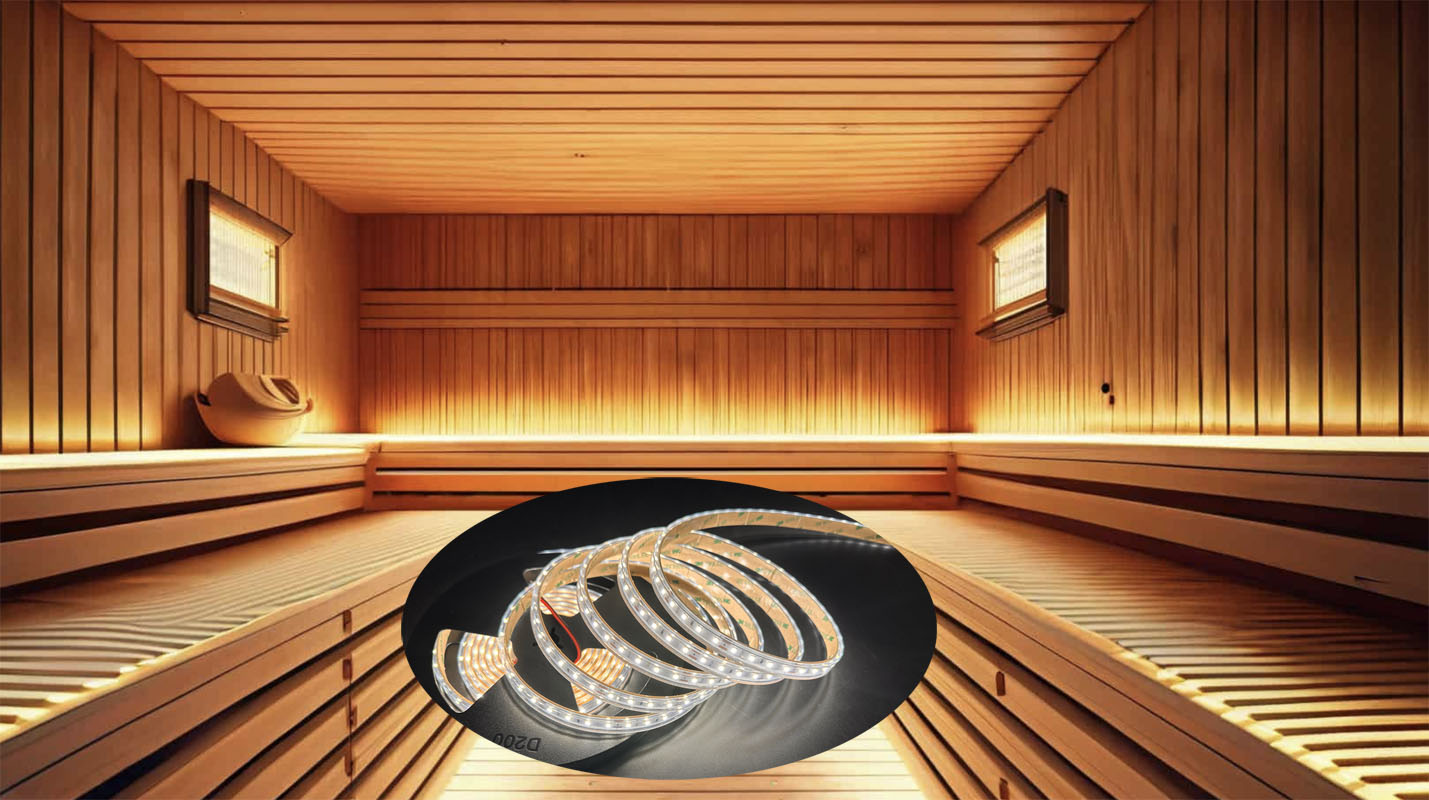
Why Sauna Environments Are Challenging for LED Lighting
Sauna rooms typically operate at temperatures between 80℃ and 100℃, while steam rooms run at 45–60℃ with nearly 100% humidity.
Although steam rooms appear more demanding because of moisture, dry saunas are actually more stressful for LED strips due to sustained extreme ambient heat.
Inside a sauna, lighting systems must withstand:
Continuous high ambient temperature
Thermal expansion and contraction
Silicone aging under heat
Indirect steam exposure
Long operating hours
This is why not every LED strip is suitable for sauna use.
Why Most Standard LED Strips Fail in Saunas
Most conventional LED strips are designed for indoor ambient conditions below 50–60℃.
Common failure issues in sauna installations include:
Adhesive backing melting
Silicone coating hardening or cracking
PCB overheating
LED chip burnout
Rapid lumen depreciation
When exposed to temperatures above 85℃ for prolonged periods, standard LED strips experience dramatically shortened lifespan.
What Makes a High-Temperature LED Strip Suitable for Sauna?
To operate reliably in 90–100℃ environments, an LED strip must be engineered differently.
1. High Ambient Temperature Rating (Up to 100℃)
The entire structure — LED chips, PCB, solder joints, and encapsulation materials — must tolerate extreme thermal stress without deformation or performance loss.
A true sauna-rated LED strip should clearly specify its maximum ambient temperature rating.
2. Integrated IP67 Silicone Protection
In sauna and steam environments, moisture protection remains essential.
An IP67 integrated extrusion silicone tube provides:
Full sealing against condensation
Protection from steam penetration
Resistance to long-term humidity exposure
However, it is important to note that IP rating measures moisture protection — not heat resistance. Both factors must be considered.
3. High-Performance LED Chips (3030 Type or Equivalent)
Larger LED packages such as 3030 chips offer improved heat dissipation compared to smaller formats.
High-quality chips help maintain stable lumen output under elevated temperatures.
4. Clear High-Temperature Warranty Policy
Professional manufacturers specify warranty periods under controlled temperature conditions, for example:
5 years warranty under ≤85℃
Reduced warranty under ≤100℃
This transparency indicates actual testing capability.
What IP Rating Is Required for Sauna LED Lighting?
The required IP rating depends on the application:
| Application | Recommended IP | Main Concern |
|---|---|---|
| Dry Sauna | IP65+ | Heat resistance |
| Steam Room | IP67+ | Moisture & condensation |
| Bathroom | IP65 | Splash protection |
While IP67 is generally recommended for steam rooms, temperature tolerance up to 100℃ is the more critical requirement in dry sauna environments.
Recommended Specifications for Sauna LED Strip
For reliable sauna lighting performance, the LED strip should include:
DC24V low-voltage input (safer installation)
Ambient temperature tolerance: -25℃ to 100℃
IP67 integrated silicone encapsulation
80 LEDs per meter for uniform illumination
Optional 4.8W/m or 9.6W/m power selection
High heat-resistant structural design
These specifications ensure stable performance in extreme sauna conditions.
Installation Best Practices for Sauna LED Lighting
Proper installation is equally important to maximize lifespan:
Avoid placing strips directly above sauna heaters
Install under benches or behind wooden slats for indirect lighting
Use aluminum profiles to enhance heat dissipation
Keep power supplies outside the sauna cabin
Avoid excessive bending or mechanical stress
Correct installation significantly reduces thermal strain.
Frequently Asked Questions
1. Can LED strip lights be installed directly inside a sauna?
Yes, but only if they are specifically rated for high ambient temperatures up to 100℃.
2. Is IP65 sufficient for sauna lighting?
For dry sauna installations, IP65 is generally sufficient.
For steam rooms, IP67 is recommended.
3. How long do LED strips last in a sauna?
Standard LED strips may fail quickly above 85℃.
High-temperature rated strips engineered for 100℃ environments can operate reliably for years when properly installed.
4. What voltage is safest for sauna LED lighting?
Low-voltage systems such as DC24V are recommended for improved electrical safety and stable performance.
Final Thoughts
Not all LED strips are suitable for sauna environments.
If the strip is not specifically designed for high ambient temperatures up to 100℃, premature failure is highly likely.
When selecting LED strip lighting for sauna or steam room applications, always verify:
Maximum ambient temperature rating
IP protection level
LED chip type
Warranty under high-temperature conditions
Choosing a properly engineered high-temperature LED strip ensures safety, durability, and consistent lighting performance.