Skip to content
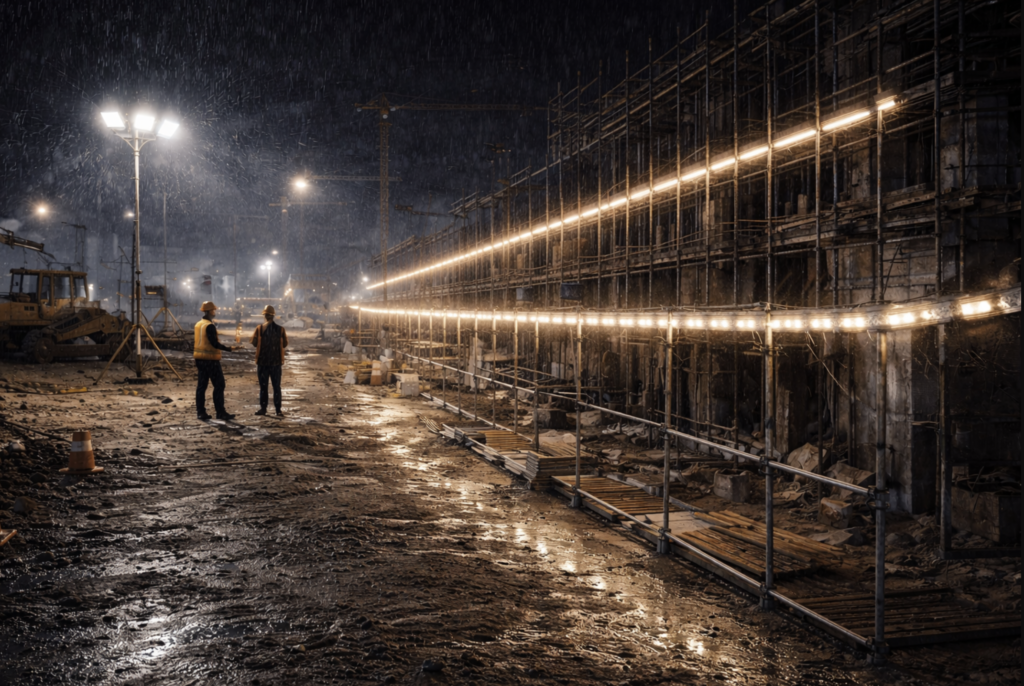
Construction sites often require temporary lighting to maintain safe working conditions during night operations or in low-visibility environments. However, simply installing lights without proper planning can lead to uneven illumination, shadow areas, and inefficient energy use.
Understanding how to calculate lighting coverage for construction sites helps contractors design lighting systems that provide consistent visibility across the entire jobsite.
This guide explains the key factors involved in construction lighting coverage, including illumination levels, mounting height, distance, and lighting layout.
Quick Steps to Estimate Construction Lighting Coverage
Before performing detailed lighting calculations, contractors often follow a basic planning process:
Measure the total work area or installation length
Determine the required illumination level (lux)
Identify mounting height or installation position
Choose the lighting type (floodlight or linear lighting)
Estimate fixture spacing and coverage overlap
These steps provide a practical starting point for designing temporary lighting systems.
Understanding Lumens, Lux, and Lighting Coverage
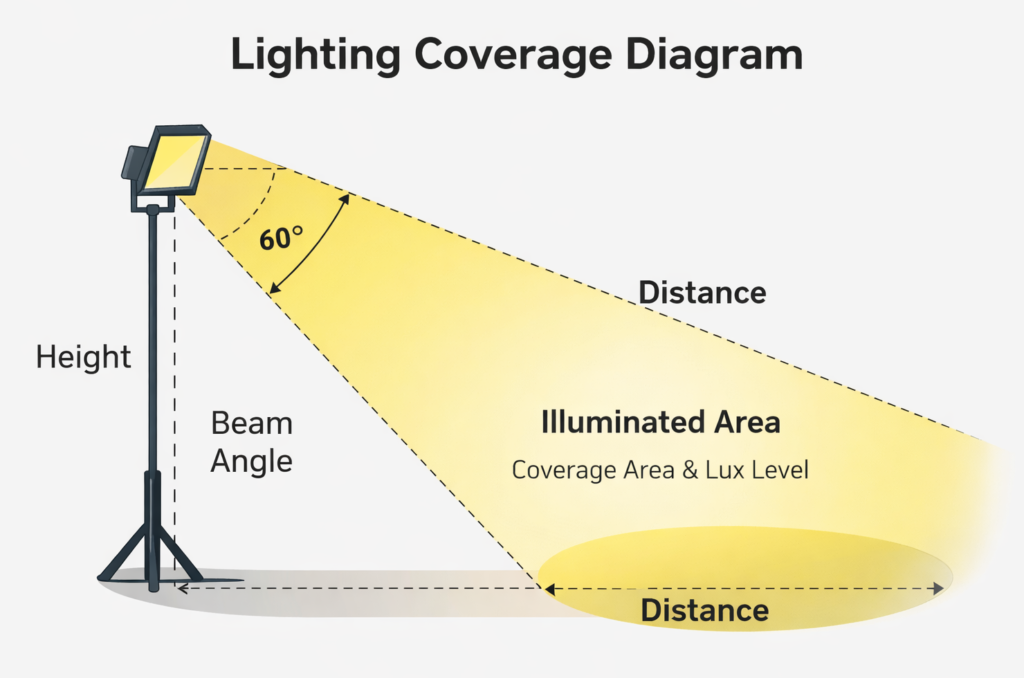
When discussing lighting coverage, three key lighting parameters are commonly used:
Lumens (lm) – total light output from a light source
Lux (lx) – illumination level on a surface
Area (m²) – the surface receiving the light
In simplified explanations, illumination is sometimes described as the relationship between luminous flux and area.
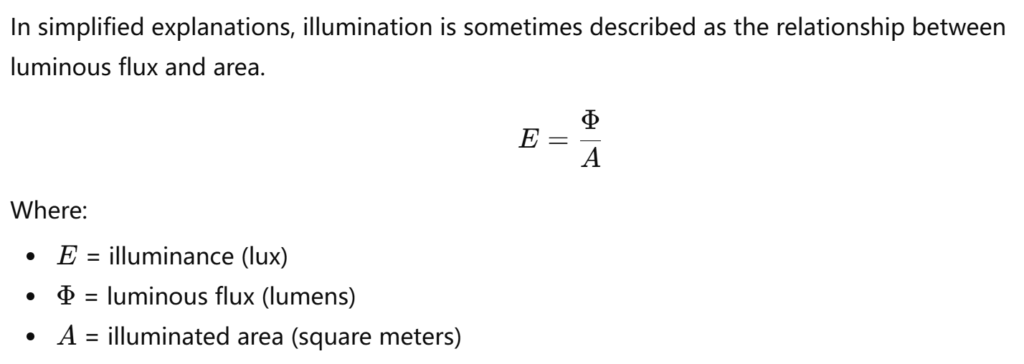
However, this formula only represents a theoretical relationship. In real construction lighting design, illumination levels are also affected by distance, beam angle, mounting height, and environmental conditions.
How Distance Affects Lighting Coverage
Lighting intensity decreases as the distance between the light source and the illuminated surface increases.
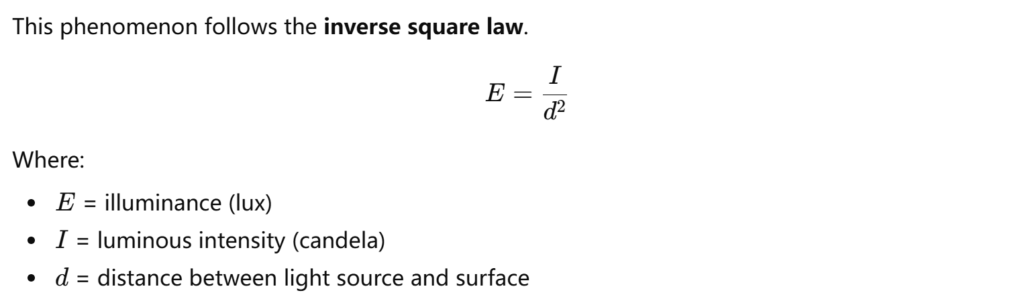
In practical terms:
If the distance doubles, illumination becomes one quarter.
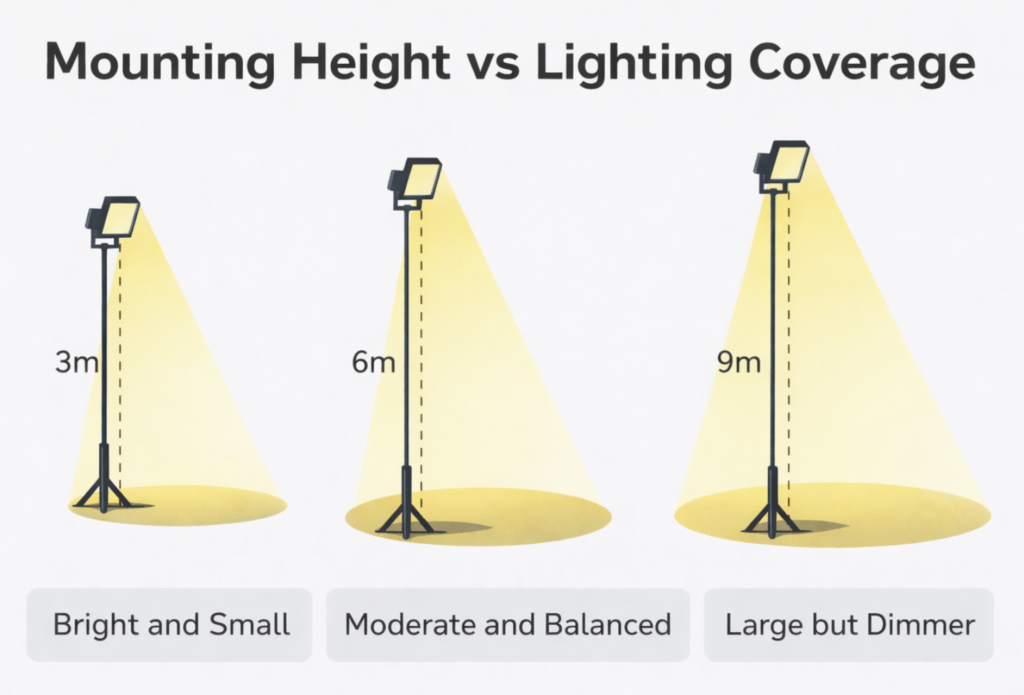
Installation height significantly influences lighting coverage.
For example, floodlights mounted on tall poles illuminate a wider area but provide lower lux levels on the ground.
Typical Illumination Levels for Construction Work
Different construction tasks require different illumination levels.
| Construction Activity | Recommended Illumination |
|---|---|
| General site access | 50–100 lux |
| Standard construction work | 100–200 lux |
| Detailed installation work | 200+ lux |
| Safety perimeter lighting | 50–100 lux |
Instead of focusing only on brightness, lighting planners should aim for uniform illumination across the work area.
How Mounting Height Influences Lighting Coverage
Mounting height plays a major role in determining how light spreads across a construction site.
General guidelines include:
| Mounting Height | Lighting Effect |
|---|---|
| 3–4 meters | Strong brightness, limited coverage |
| 5–6 meters | Balanced brightness and coverage |
| 8–10 meters | Large coverage area, lower lux level |
Temporary construction floodlights are often installed on tripods or portable poles between 4 and 6 meters high to achieve effective site coverage.
Typical Lighting Layout for Construction Sites
Construction lighting layouts generally fall into three main categories.
Floodlight Layout
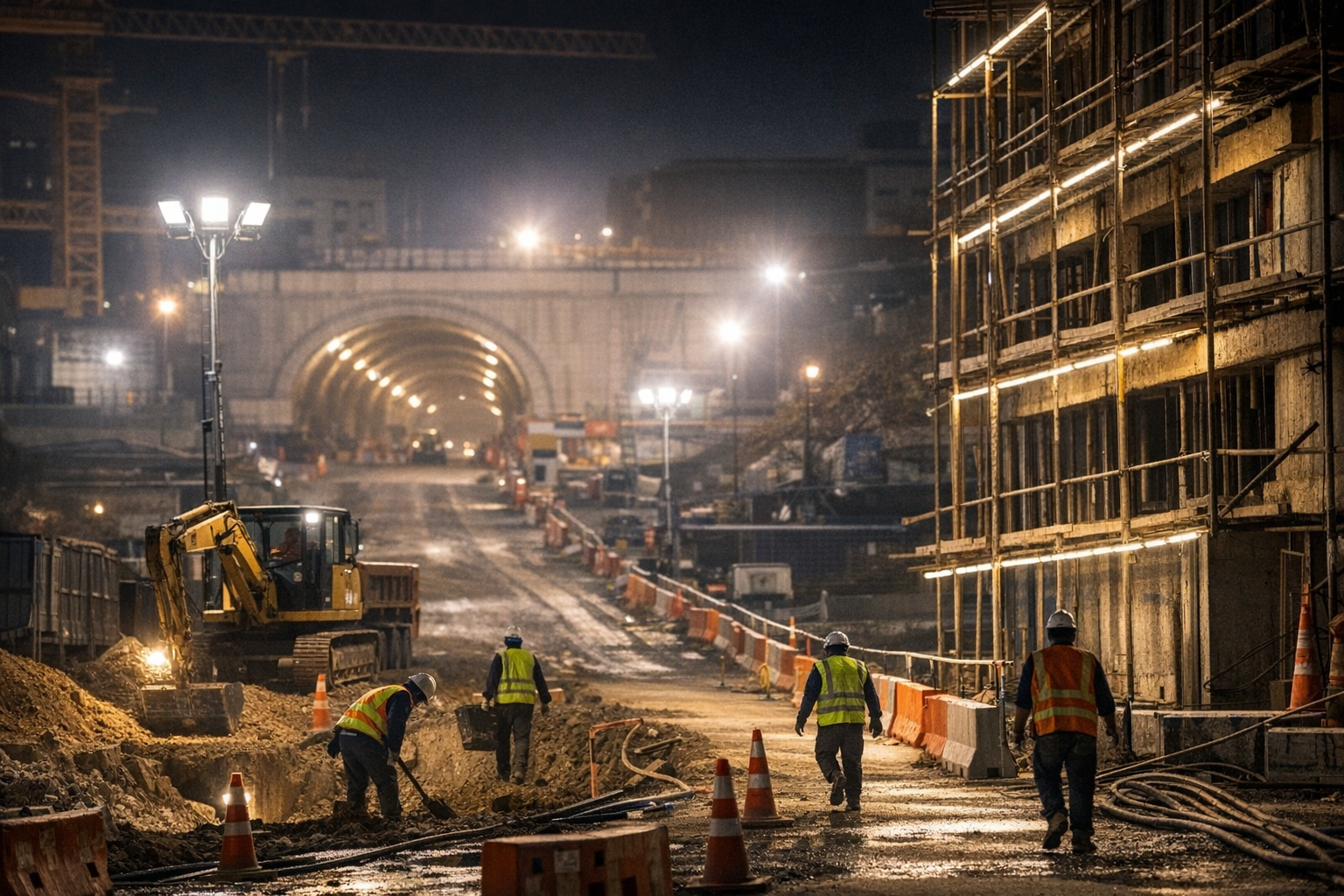
Floodlights are commonly used for:
open construction areas
heavy equipment zones
road construction sites
They are usually mounted on poles or tripods to illuminate large spaces.
However, if floodlights are spaced too far apart, shadow areas may appear between fixtures.
Linear Lighting Layout
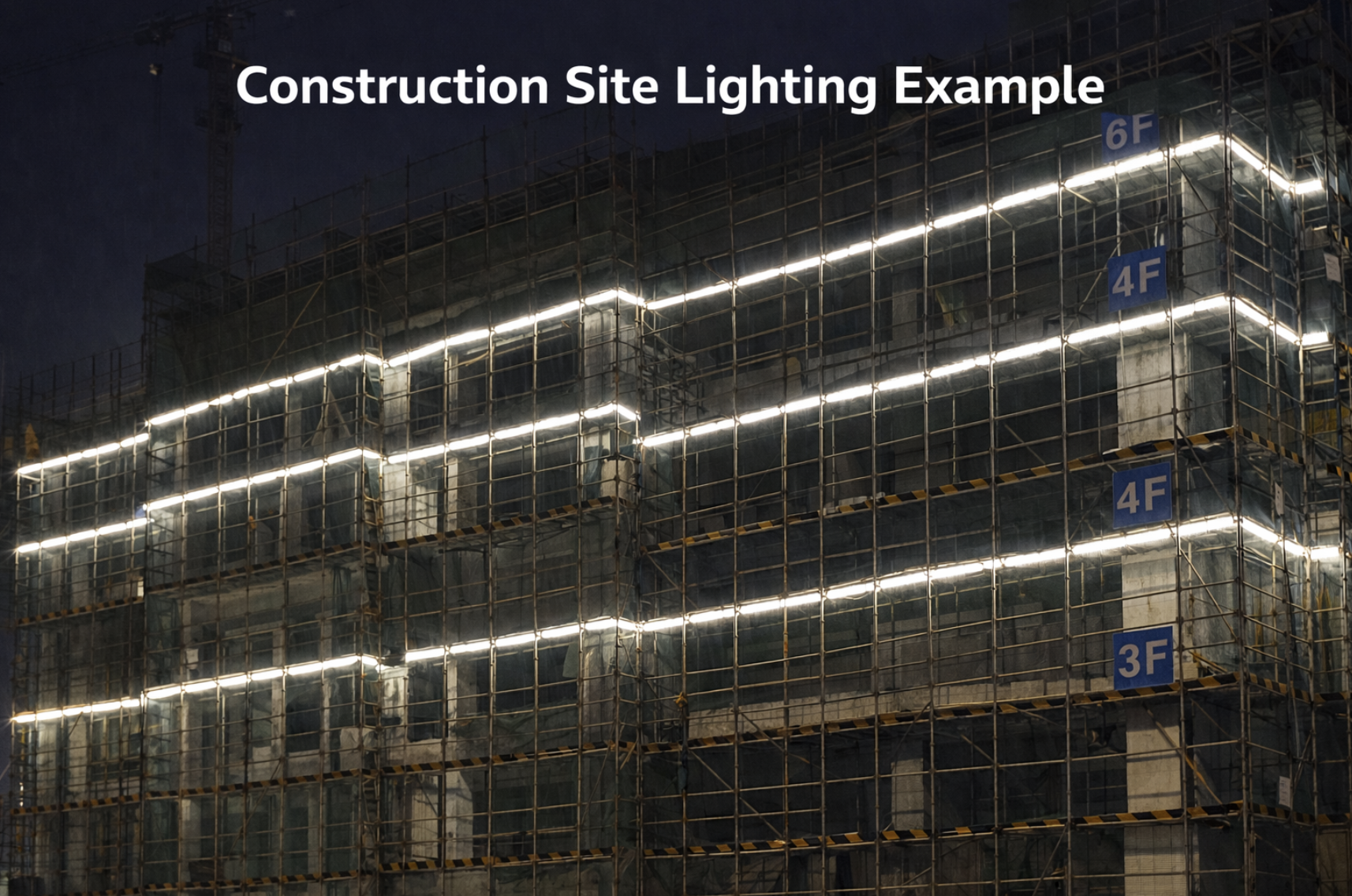
Linear lighting systems such as LED strip lighting are often used for:
scaffolding lighting
tunnel construction
perimeter safety lighting
long work corridors
Linear lighting provides continuous illumination, reducing dark zones along working paths.
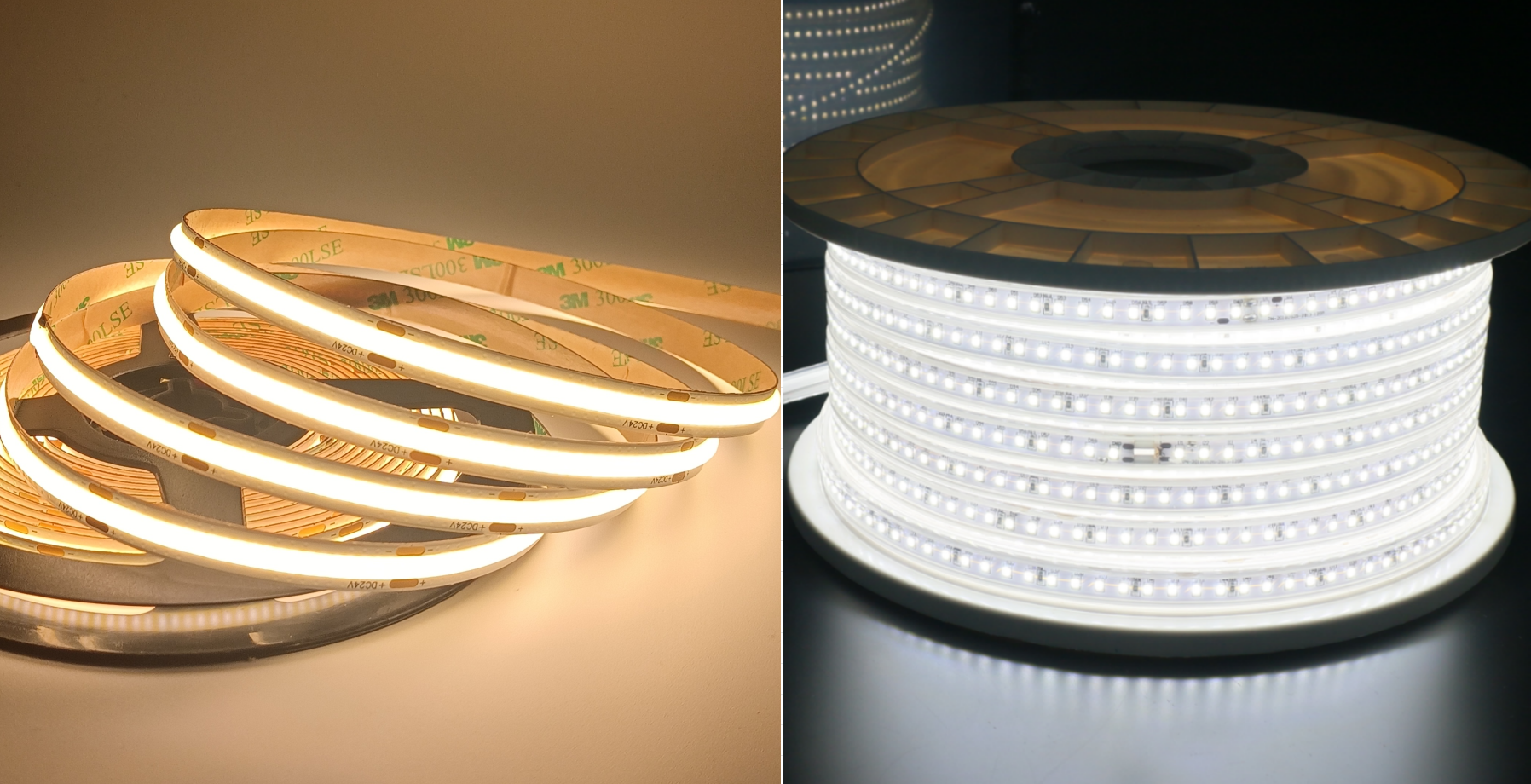
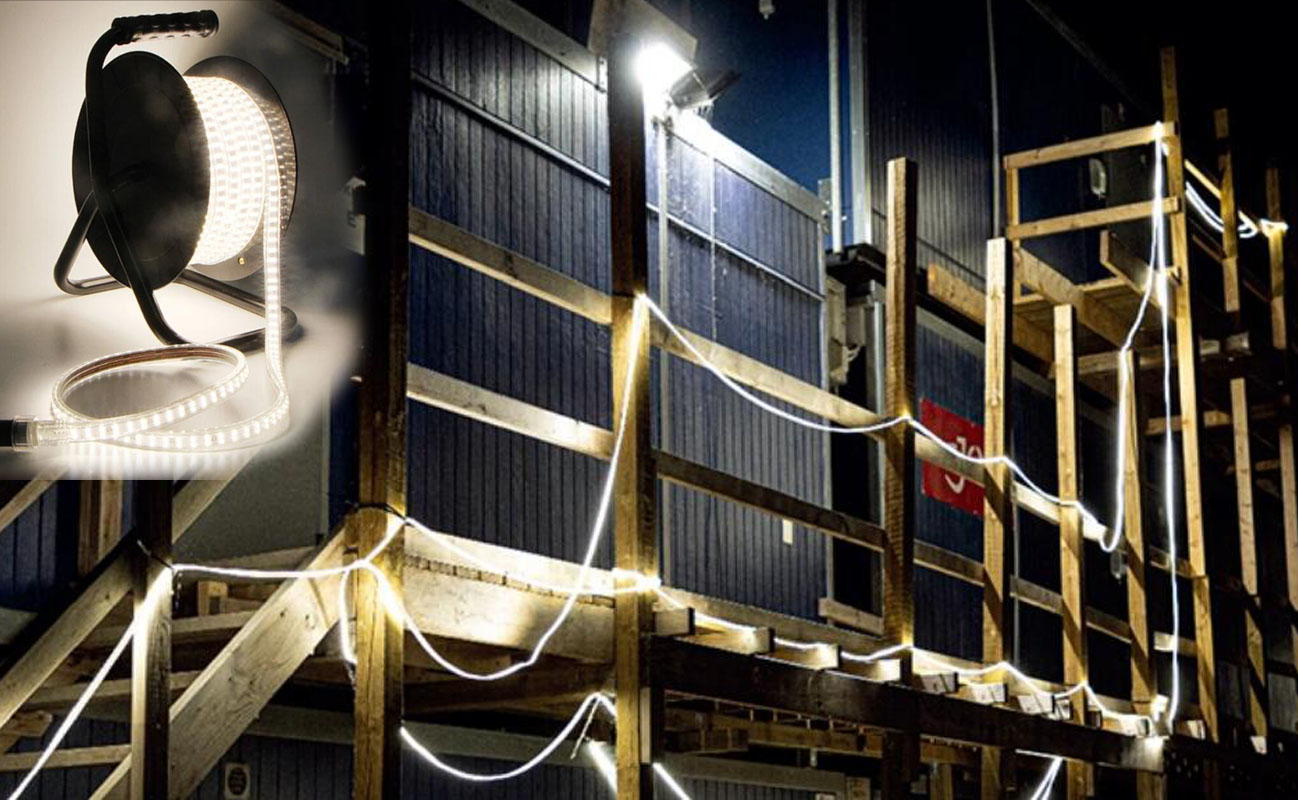
For long construction structures, many contractors choose
high voltage LED strip lighting systems
because they allow long installation runs and simplified wiring.
Hybrid Lighting Layout
Many construction sites use a combination of lighting systems:
floodlights for general area lighting
LED strip lighting for linear structures
This hybrid approach improves overall jobsite visibility and reduces shadow areas.
Example: Lighting Layout for a Tunnel Construction Project
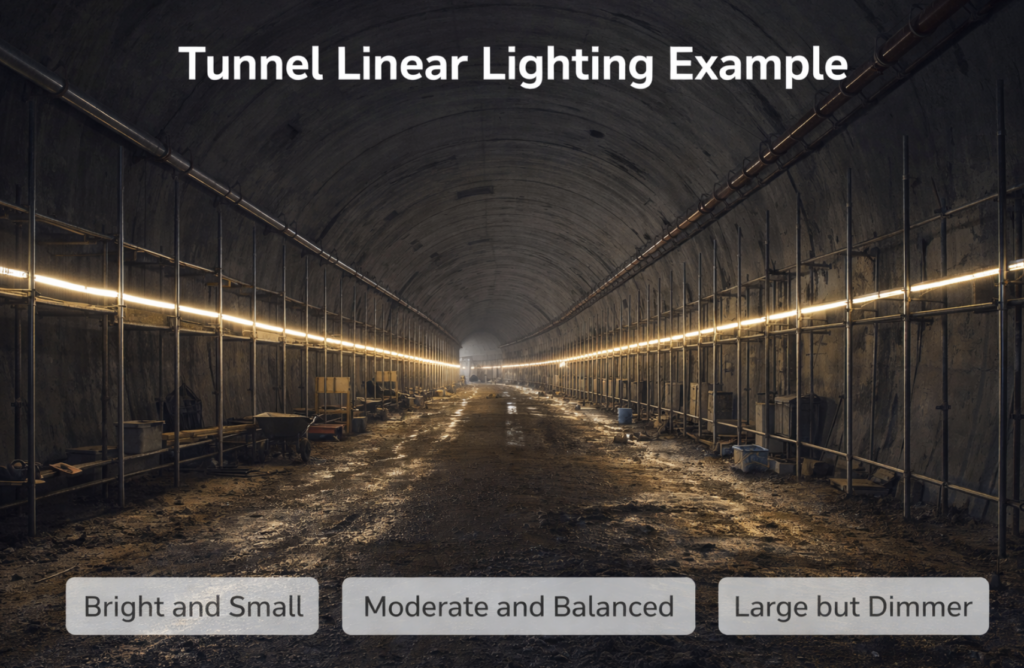
Consider a tunnel construction project that is 80 meters long.
Using only floodlights may create uneven brightness and shadow zones along the tunnel walls.
Instead, installing continuous
LED strip lighting
along the tunnel structure can provide more uniform illumination across the work area.
This approach improves worker visibility while simplifying temporary lighting installation.
Common Mistakes in Construction Lighting Planning
Some common mistakes include:
underestimating installation distance
ignoring mounting height and beam angle
placing fixtures too far apart
focusing only on lumens instead of illumination distribution
not considering obstacles or equipment blocking light
Avoiding these mistakes helps ensure safer and more efficient lighting coverage.
FAQ: Construction Lighting Coverage
What lux level is required for construction sites?
Most construction work areas require 50–200 lux, depending on the type of work being performed.
How do you avoid dark spots on construction sites?
Proper fixture spacing, overlapping lighting coverage, and correct mounting height help prevent dark zones.
What lighting is best for long construction areas?
For tunnels, scaffolding, and other long structures, continuous lighting systems such as LED strip lighting often provide more uniform visibility than isolated light sources.
Conclusion
Calculating lighting coverage for construction sites involves evaluating several factors, including illumination requirements, mounting height, beam angle, and fixture spacing.
While theoretical formulas provide a useful starting point, real construction lighting design should consider practical site conditions to achieve safe and uniform illumination.
For large or linear construction environments, solutions such as
110V / 220V high voltage LED strip lighting
can provide efficient and continuous temporary lighting.