Skip to content
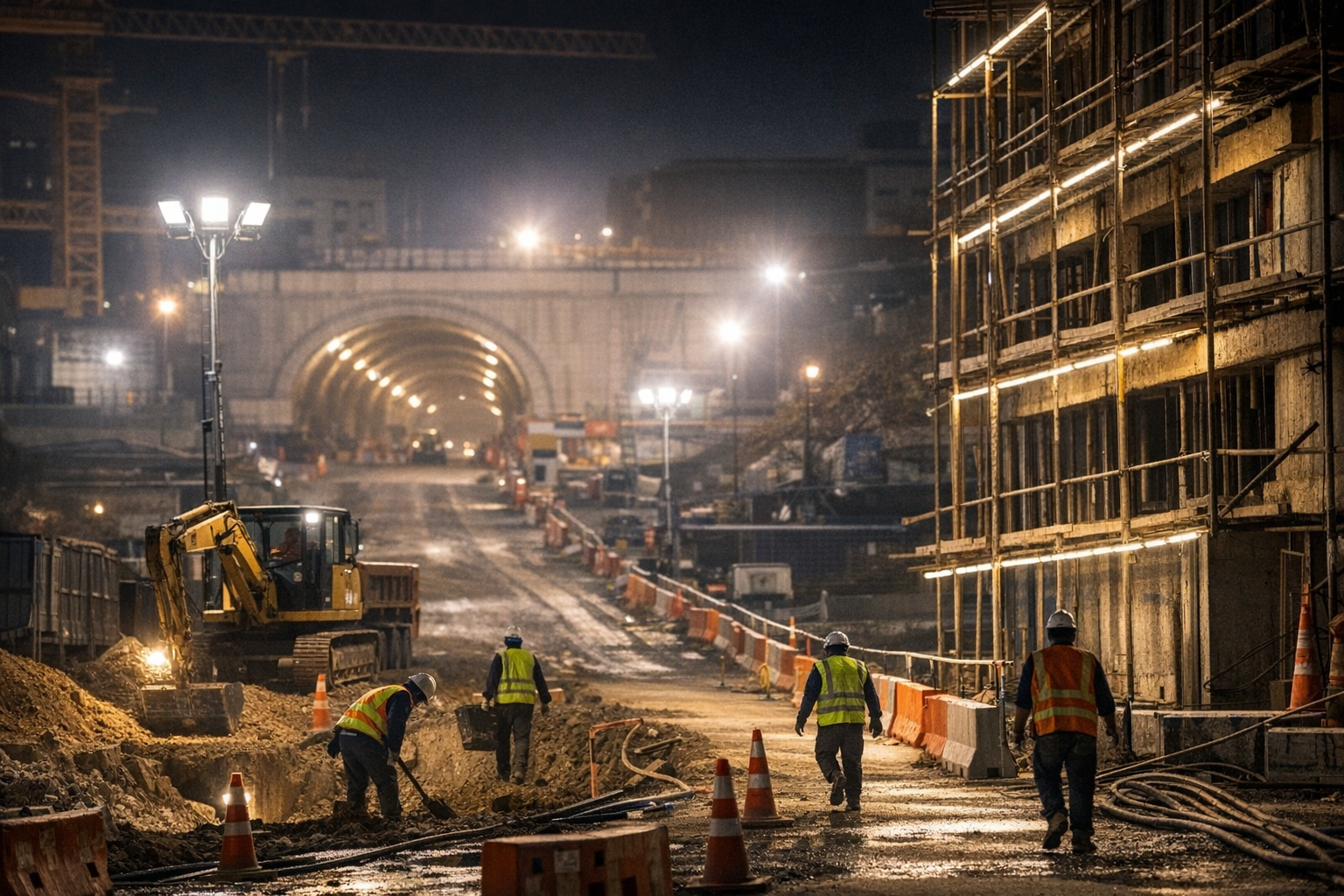
Temporary lighting is essential for construction projects operating at night, in tunnels, on scaffolding, or across large infrastructure sites. Poor planning can result in uneven illumination, unsafe working conditions, and unnecessary installation costs.
This guide explains how to design an effective temporary construction lighting system, covering illumination planning, voltage selection, waterproof requirements, and installation strategy.
Quick Checklist for Temporary Construction Lighting Planning
Before selecting any lighting products, review the following:
Define work zone type and size
Estimate total lighting coverage length
Determine required illumination level (lux)
Choose appropriate voltage system
Select suitable IP rating
Plan power distribution layout
Ensure electrical safety compliance
Following this checklist helps prevent common jobsite lighting problems.
1. Define the Work Environment and Lighting Purpose
Every construction site has different requirements.
Consider:
Is the lighting for general visibility or precision work?
Is the site open, enclosed, or linear (e.g., scaffolding, tunnel, perimeter)?
Will the lighting remain in place for weeks or months?
Examples:
Road construction requires wide-area uniform illumination.
Tunnel construction requires continuous linear lighting.
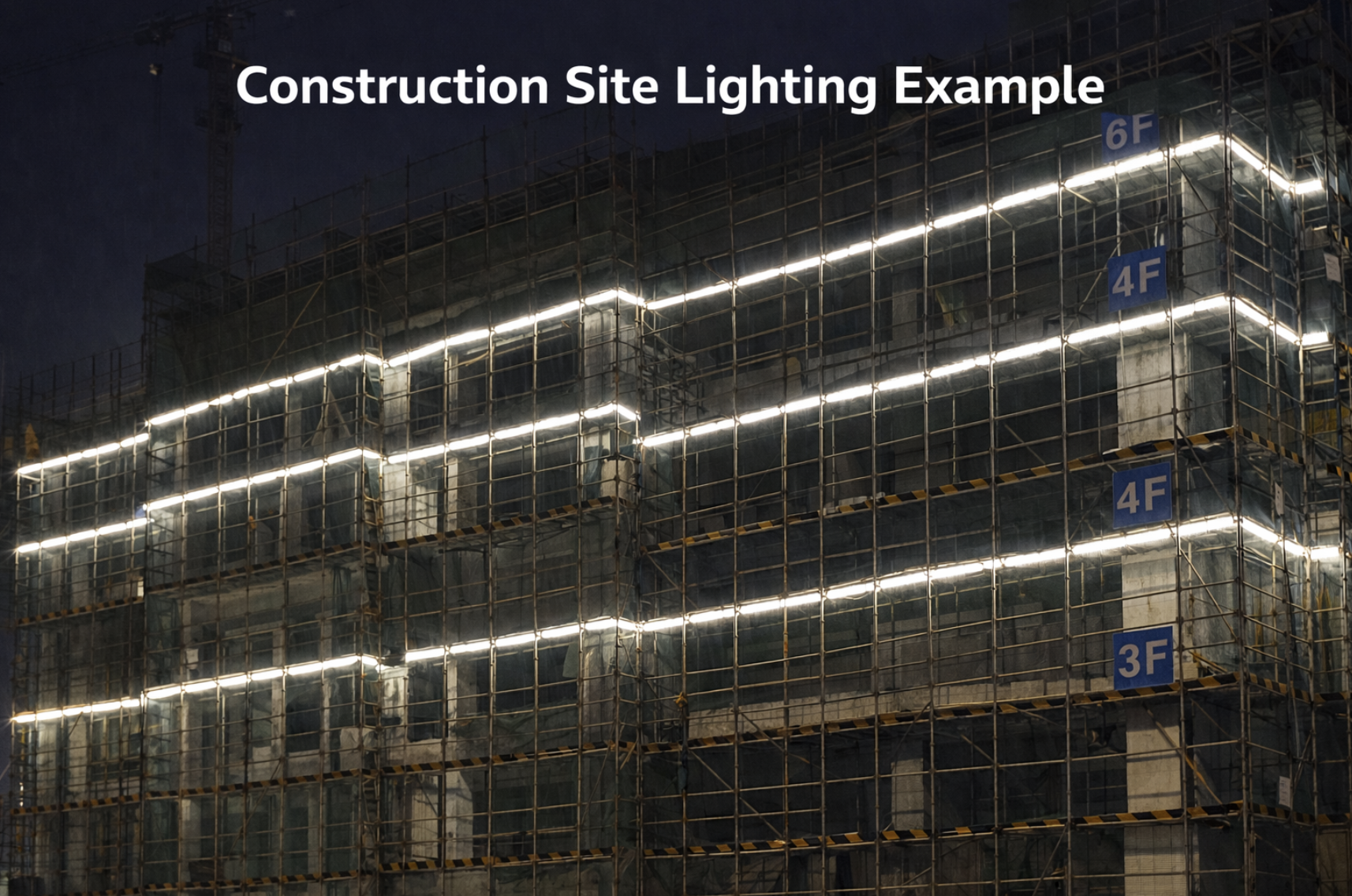
Scaffolding installations benefit from evenly distributed side lighting.
Understanding site conditions is the foundation of proper lighting design.
2. Determine Required Illumination Level (Lux)
Lighting requirements vary depending on activity type.
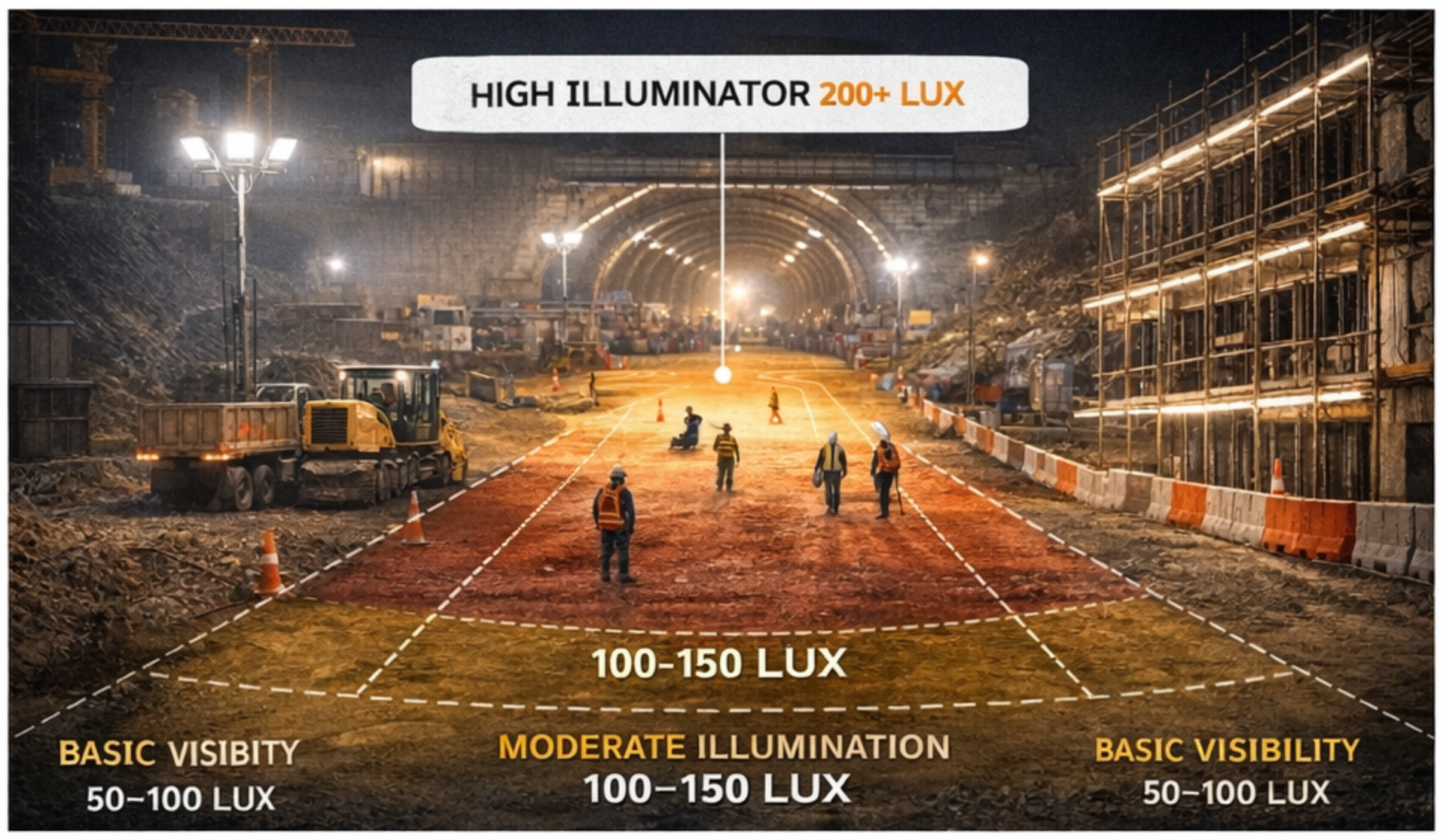
| Construction Activity | Recommended Illumination Level |
|---|---|
| General site access | Moderate illumination |
| Detailed installation work | Higher illumination |
| Perimeter safety lighting | Consistent low-to-medium |
Instead of focusing only on wattage, prioritize:
Uniform light distribution
Reduced shadow areas
Continuous visibility
In many temporary jobsite lighting systems, linear lighting solutions provide more consistent coverage than isolated flood lights.
3. Choose the Appropriate Voltage System
Voltage selection significantly impacts installation complexity.
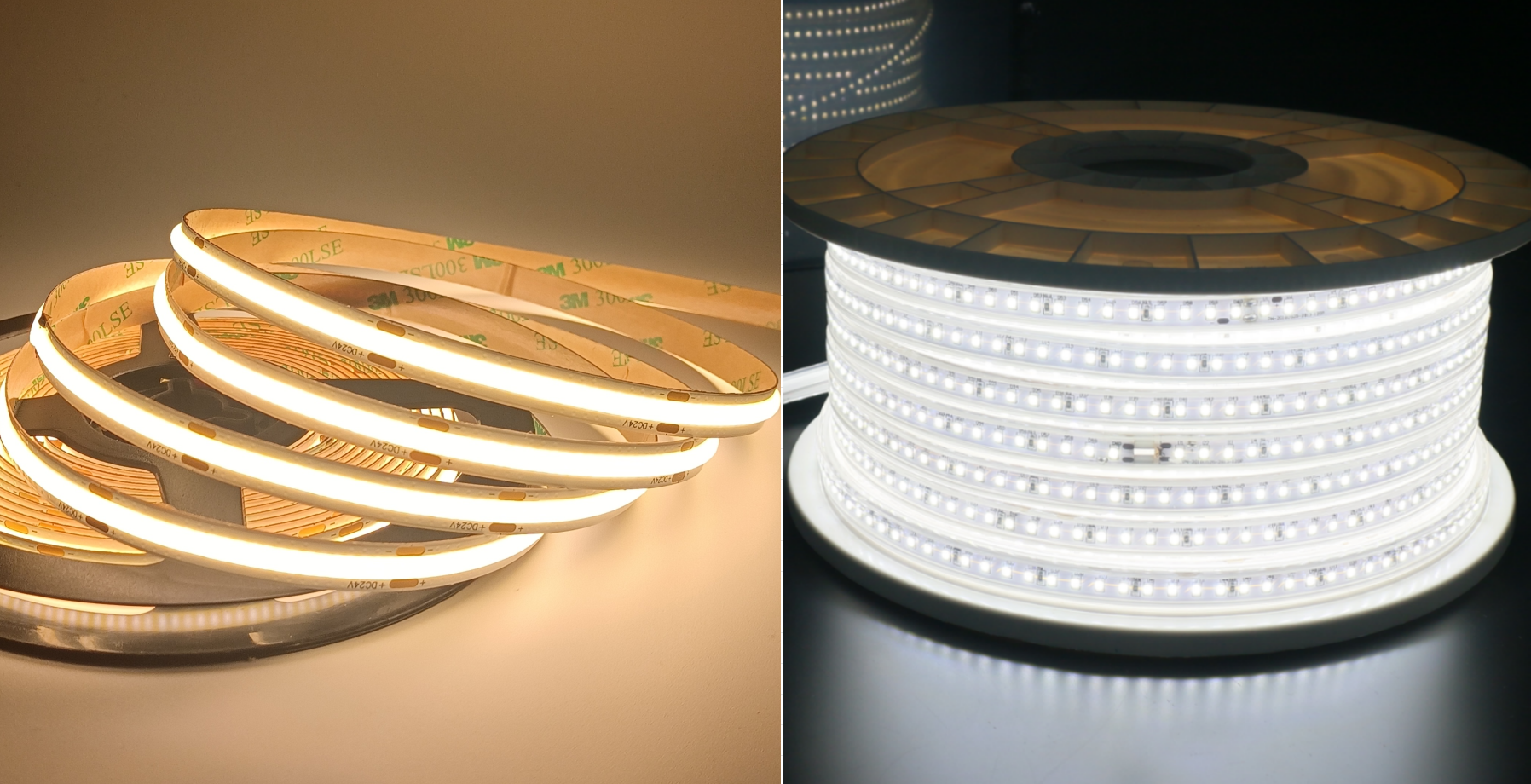
Low Voltage (12V / 24V DC)
Suitable for small or controlled environments
Requires external drivers
Limited continuous run length
Requires multiple power injection points
Low voltage systems are often used in decorative or short-distance installations.
High Voltage (110V / 220V AC)
Direct AC input
Longer continuous runs
Fewer connection points
Reduced wiring complexity
For large-scale construction projects or long-distance temporary installations, many contractors prefer
👉 high voltage LED strip lighting for construction sites
Simplified power distribution improves installation efficiency and scalability.
4. Plan Power Distribution and Voltage Drop
Voltage drop is a key consideration in large construction areas.
Low voltage systems may require power injection every few meters to maintain brightness.
High voltage systems are engineered to support extended linear runs, often exceeding 30–50 meters without noticeable brightness reduction.
When designing a temporary construction lighting system:
Map out total installation length
Identify power source locations
Minimize exposed wiring
Protect cables from mechanical damage
Efficient power planning reduces downtime and installation risks.
5. Select the Correct IP Rating for Outdoor Use
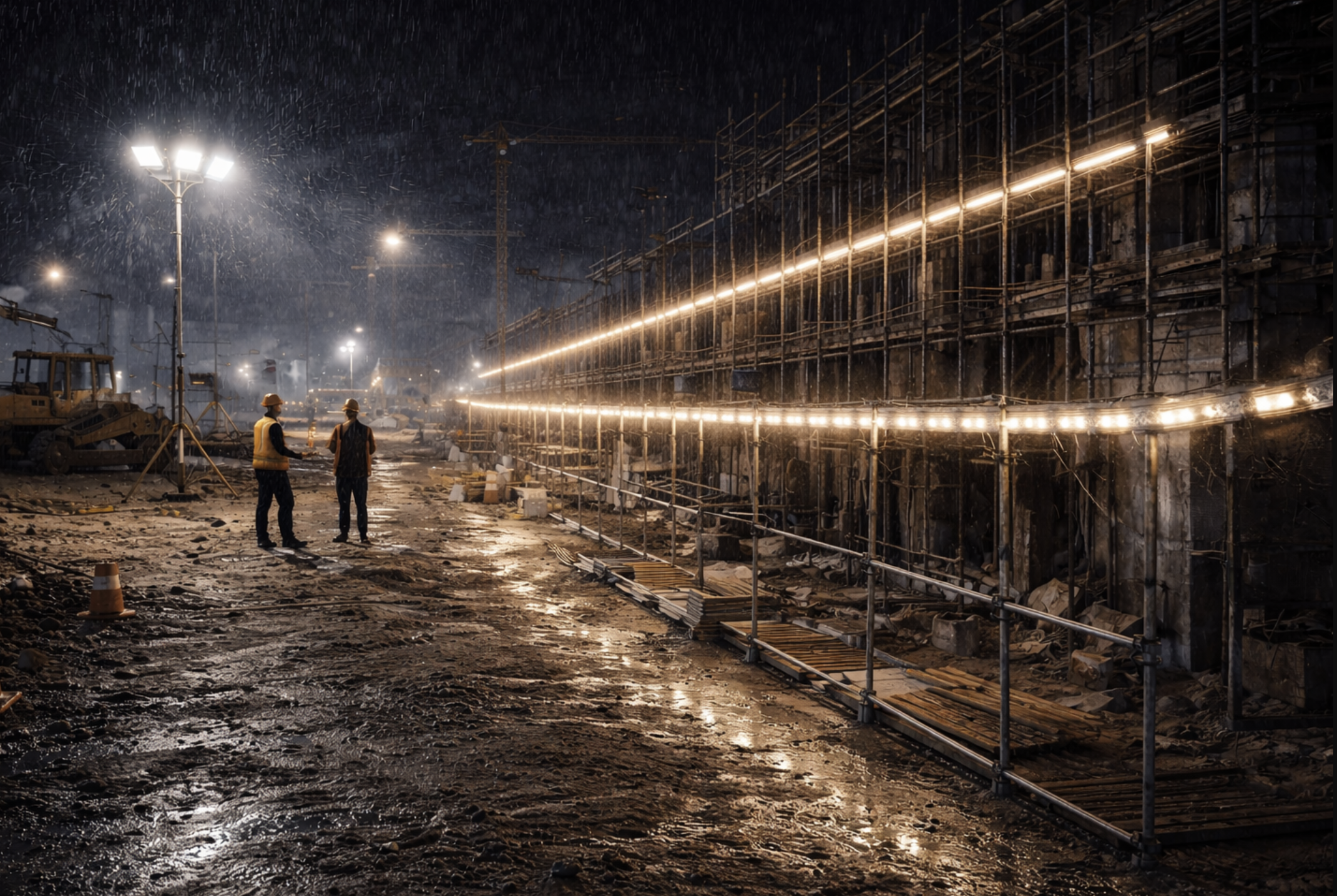
Construction sites are exposed to rain, dust, humidity, and debris.
IP65: Suitable for most outdoor environments
IP67: Recommended for heavy rain or exposed tunnel areas
Ensure connectors, end caps, and cable joints maintain waterproof integrity.
Choosing the right protection level improves system durability and reduces maintenance issues.
6. Consider Energy Efficiency and Operating Duration
Many construction projects operate overnight.
Energy efficiency becomes important when lighting runs for extended periods.
Evaluate:
Power consumption per meter
Total system wattage
Operating hours per day
Cost impact over project duration
An efficient temporary lighting system can significantly reduce operating costs, especially in large infrastructure projects.
7. Ensure Safety and Compliance
Safety depends on both product selection and proper installation.
Key considerations include:
Proper insulation
Waterproof connectors
Cable routing protection
Compliance with local electrical regulations
Installation by qualified personnel
Voltage level alone does not determine safety. Correct system design and secure installation are essential.
Real-World Construction Scenario
Consider a 100-meter tunnel construction project requiring continuous night illumination.
Using isolated flood lights may create shadow areas and uneven brightness.
A properly planned linear lighting system reduces dark zones and simplifies installation along the tunnel structure.
For scalable jobsite lighting solutions,
👉 110V / 220V LED strip systems for construction projects
Common Mistakes in Temporary Construction Lighting Planning
Underestimating installation distance
Ignoring voltage drop
Choosing insufficient waterproof ratings
Overcomplicating driver placement
Focusing only on brightness instead of uniformity
Avoiding these issues improves both safety and cost efficiency.
Conclusion
Effective temporary construction lighting planning requires evaluation of site conditions, illumination needs, voltage configuration, environmental exposure, and installation strategy.
For large-scale or outdoor jobsite applications, high voltage LED strip lighting often provides a practical balance between scalability, simplified installation, and consistent illumination.
Proper planning improves safety, reduces labor time, and ensures reliable performance throughout the construction project.